Benefits - SMART Target Setting Using The STHC
There’s no point in setting targets if they can’t be measured! The STHC analysis output provides authorities with hard figures that will allow officers to quantify the current school travel situation down to individual school level, benchmark it, point them in the right direction of local remedial action and then subsequently give them a measure of its effectiveness on the ground.
Follow the links below for examples of how the STHC can be used to set SMART targets:-
 Short Term:Compile A School "Target-list"
A classic "quick win" for School Travel Advisers upon receiving the STHC analysis data is to re-order the Key Spatial Results Table spreadsheet by "the number of pupils within walk threshold travelling by car" column. This will give them a target list in descending order of the schools with the biggest potential for modeshift, which can then form the basis of their day-to-day activities for the next few weeks.
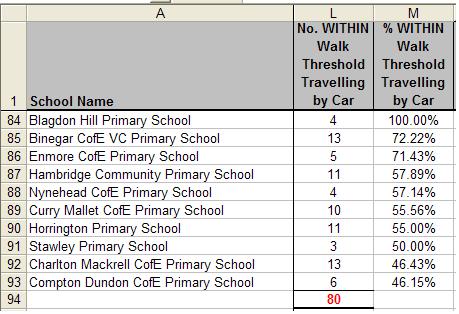
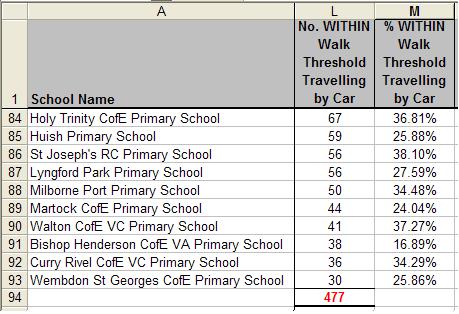
For example the two screenshots opposite show the top 10 "offending" primary schools in an authority, ranked by the number of Pupils Within the Walk Threshold Travelling by Car, firstly expressed as a percentage of the total number of pupils at the school (top) and then as an absolute number (bottom).
As you can see if we only went by percentages there are only 80 potential modal shift targets spread over the top 10 schools compared to 477 if we play the numbers game. A 10% modal shift in these schools would actually result in a lot more CO2 saved!
Medium Term: Increase Walking & Cycling Distances
In the medium term the STA Team can look at ways to increase those 85th percentile (threshold) distances by encouraging people to walk and cycle just that little bit further before resorting to their cars. This is where partnership working with local Walking & Cycling initiatives will pay off.
Longer Term: Reduce The Total "Child Miles" Travelled
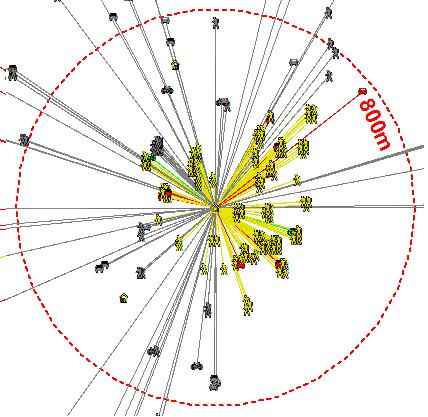
In the longer term it is worth looking closer at all those "greyed" pupils who are passing their local (and often several other) schools on their way to their educational establishment of choice. What can be done to encourage them to walk or cycle to their nearest school rather than be driven to a school much further away because there are no other viable ways of getting there? Ideally authorities want to be making parents realise the travel implications as part of the process of choosing their children’s school rather than having to deal with the consequences of their choice later with long school-runs across town at the busiest times of day.
At an operational level the "nearest distance" figures represent the shortest possible journey for that given set of pupils, which obviously is important when it comes to realistic target setting for authorities, either by themselves or central government (our figures show that the total "child miles" covered by cars in the school run would be reduced by at least 60% if all pupils went to their nearest eligible school (and that’s not taking into account any modeshift!).